
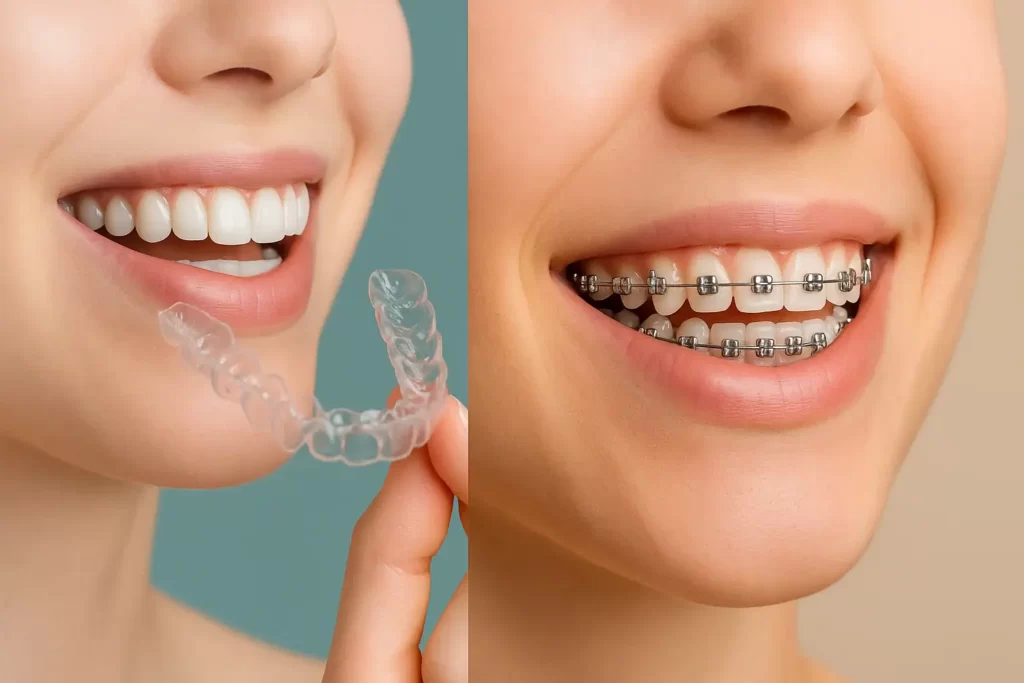
Invisalign is Popular, But is it Suitable for You?
As an experienced orthodontist in the Illawarra who has centred my career on the philosophy that good ethics is good business, it’s important that I provide honest evaluations and recommendations for all prospective patients, especially when they visit South Coast Orthodontics for a free consultation.
In recent years, Invisalign suitability has become one of the most common topics discussed in modern orthodontics. While Invisalign is widely recognised as a discreet and convenient alternative to traditional braces, it is not always the right solution for every patient.
Let’s explore when Invisalign works best, and when it may not.
What Makes Invisalign So Popular?
Invisalign has gained popularity because it offers:
- Clear, virtually invisible aligners
- Removable convenience
- Greater comfort compared to metal braces
- Minimal disruption to daily life
However, popularity does not always equal suitability.
Understanding whether Invisalign is suitable for you depends on clinical factors, lifestyle, and long-term treatment goals.
1. Invisalign is Best for Mild to Moderate Cases
Invisalign is primarily designed to treat:
- Mild to moderate crowding
- Spacing issues
- Minor bite irregularities
If you have more complex orthodontic problems, such as severe malocclusion or jaw discrepancies Invisalign suitability decreases significantly.
In these cases, traditional braces may be more effective because they allow:
- Greater control over tooth movement
- More precise force application
- Better correction of complex bite issues
2. Compliance is Critical for Invisalign Success
One of the biggest factors affecting Invisalign suitability is patient compliance.
Aligners must be worn for:
20–22 hours per day
Failure to follow this can:
- Delay treatment
- Compromise results
- Lead to incomplete correction
If consistency is a concern, fixed braces may be a more reliable option, as they do not depend on patient discipline.
3. Age Matters in Invisalign Suitability
Invisalign is generally more suitable for:
- Adults
- Older teenagers with fully erupted permanent teeth
For younger patients:
- Jaw growth is still ongoing
- Tooth eruption is incomplete
This makes traditional braces more effective, as they allow better control during developmental stages.
4. Invisalign Has Limitations in Complex Cases
While Invisalign technology continues to evolve, there are still limitations.
Invisalign may not be ideal for:
- Severe bite problems (overbite, underbite)
- Complex tooth rotations
- Vertical tooth movements
- Skeletal discrepancies
In such situations, treatment may require:
- Traditional braces
- Combined orthodontic approaches
- In some cases, orthognathic surgery
This is why a proper clinical assessment is essential before determining Invisalign suitability.
5. Invisalign Focuses on Alignment, Not Always Structure
Invisalign is highly effective for improving:
- Tooth alignment
- Smile aesthetics
However, it is not always the best solution for:
- Jaw alignment issues
- Structural bite correction
A comprehensive orthodontic plan ensures both function and aesthetics, not just appearance.
So, Is Invisalign Suitable for You?
The truth is simple:
Invisalign is an excellent treatment but only when it is the right treatment.
At South Coast Orthodontics, every recommendation is based on:
- Clinical evidence
- Patient-specific needs
- Long-term oral health outcomes
If Invisalign is suitable for you, we will proceed confidently.
If it’s not, we will guide you toward a better alternative.
Either way, the goal remains the same:
A healthy, functional, and confident smile.
Final Thoughts
While Invisalign offers incredible benefits, it is not a one-size-fits-all solution.
Your treatment should be based on:
- Precision
- Honesty
- What is clinically best for you not just what is popular
If you’re considering treatment and wondering about your Invisalign suitability, the best next step is a professional consultation.
Yours truly,
Dr Kamal Ahmed
P.S. My goal in life is to become the best orthodontist in the Illawarra. Guess what the prize is? A little plaque.
